
Inspirational Quotes by APJ Abdul Kalam to Motivate You

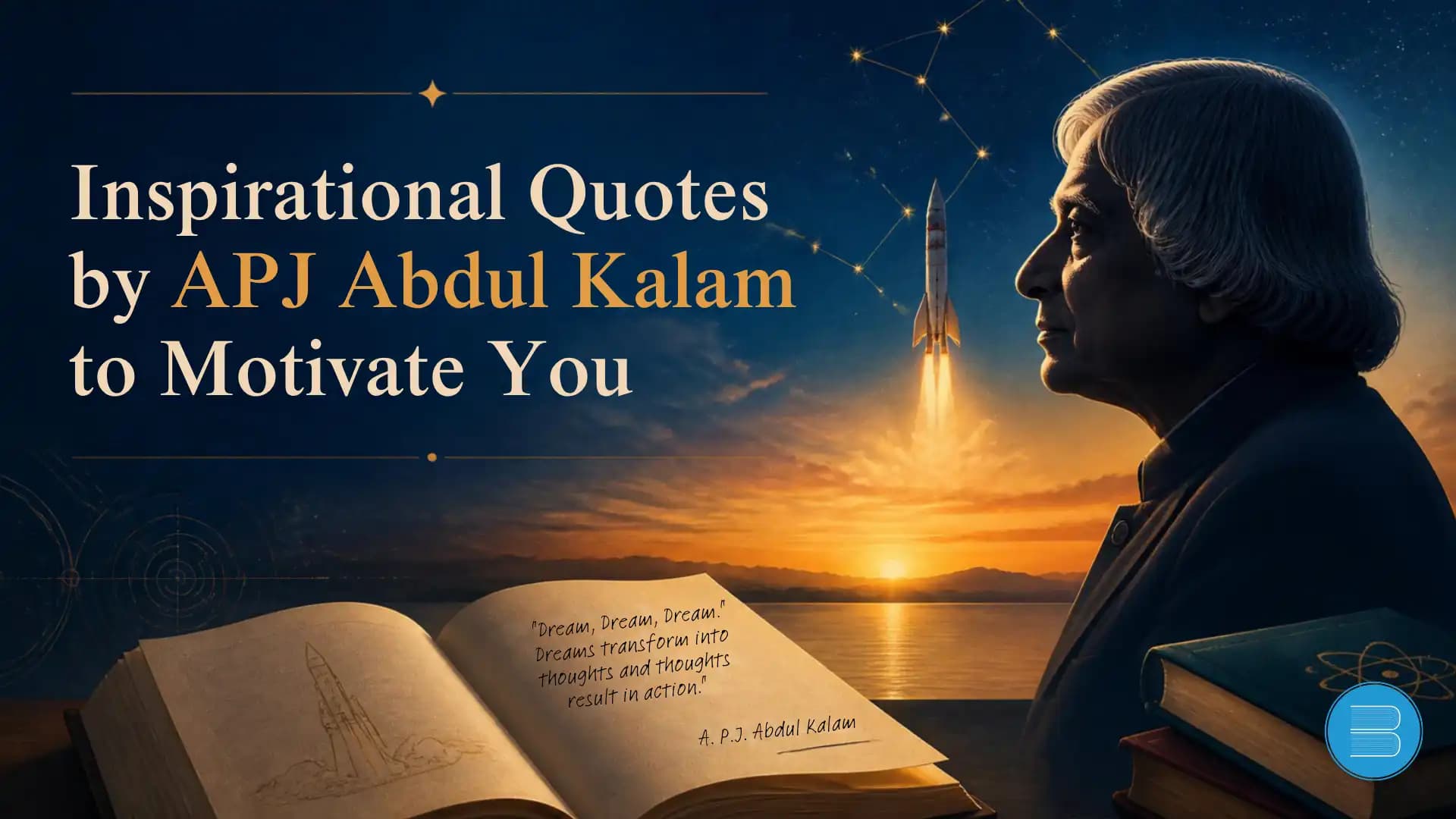
Some words motivate you for a moment. Others stay with you long after you have finished reading them. Inspirational Quotes by APJ Abdul Kalam belong to the second category. His ideas about dreams, knowledge, courage, hard work, creativity, and purposeful action continue to connect with students, readers, authors, poets, and anyone trying to move forward.
Dr. A.P.J. Abdul Kalam was not just the eleventh president of India; he was also a scientist, an educator, an author, and a passionate mentor for young individuals. As per the official biography of Dr. A.P.J. Abdul Kalam, it talks about the achievements of Dr. Kalam in relation to India’s space and defense program and then his contributions in education and dealing with the students of India.
What makes the quotation of Dr. A.P.J. Abdul Kalam unique and special is the practical nature of the quote. Dreaming according to him was not just wishful thinking; rather it always included thoughts and knowledge along with efforts and actions.
In this article, we explore 12 Inspirational Quotes by APJ Abdul Kalam, explain the ideas behind them, and show how readers and writers can turn these sayings of Abdul Kalam into everyday motivation.
A note on authenticity: Many Kalam quotations circulate online in shortened or altered forms. The quotations selected here are drawn from the official President of India archive wherever possible, making the article more useful for readers looking for reliable quotations by Abdul Kalam.
Who Was Dr. A.P.J. Abdul Kalam?
Dr. Avul Pakir Jainulabdeen Abdul Kalam was born on October 15, 1931, in Rameswaram, Tamil Nadu. He earned a degree in aeronautical engineering and was responsible for India’s space and defense technology programs.
According to the presidential biography, his contributions were towards the SLV-III project, the Rohini satellite launch, the development of Indian launch vehicles, and the Integrated Guided Missile Development Program.
However, Kalam made more impact than just scientific knowledge.
As a former 11th president of India, from 2002 to 2007, he continued to teach, write, and engage with youths. The biographical sketch specifically mentions igniting young minds through education and personal interactions with students.
Kalam’s books have been an important part of his legacy as well. The book Wings of Fire authored by him along with Arun Tiwari is the autobiography of Kalam that highlights his education and scientific experience and his life experiences at both personal and professional levels.
It is this blend of scientific reasoning and human hope that makes his words so appealing to the reader.
You may also like: Top 10 Human Psychology Books on Human Behavior
12 Inspirational Quotes by APJ Abdul Kalam
1. “Thinking leads to action.”
This brief statement brings out one of the most prominent themes in Kalam’s philosophy.
In one of his speeches, he pointed out the fact that thought should not be an intellectual activity alone; rather, he associated thought with progress and action, and added that knowledge gains meaning through application.
This theme can be of great help to a writer.
You may have a great story idea, a book of poems, or a manuscript in hand, but without its execution, it cannot become a book.
The lesson: Think deeply, but eventually turn thought into action.
For writers: Give yourself a small daily writing target instead of waiting for perfect inspiration.
2. “Knowledge with action brings prosperity.”
Often, Kalam associated education with application. He did not regard the acquisition of knowledge as something worthwhile just because it was possible to preserve or retain it. In his speeches, he stressed that knowledge should be used to find solutions and produce results.
The following quote from Abdul Kalam can also influence our perception of reading.
You may learn less from reading ten books without thinking about their content than from reading one book thoroughly and applying one lesson you learn from it.
Similarly, for writers, knowing how to use the rules of characterization, dialogue, structure, and editing is important – but applying them to your writing is more important still.
The lesson: Knowledge becomes powerful when it changes what you do.
3. “Thinking should become your capital asset.”
The most significant quotations from Abdul Kalam include the one about the importance of an independent mind.
Money, technologies, environment, and job prospects may vary. But the capacity to think, ask questions, learn, and adapt may stay useful through all this variability.
It was a recurring theme in the speeches of Abdul Kalam to students. According to the official quotation, thinking must be made a “capital asset” for people no matter what happens in their life.
For readers, it is a reminder to read actively rather than passively.
Ask:
- Why does this idea matter?
- Do I agree with the author?
- What evidence supports it?
- How could I apply it?
- What new question does it create?
The lesson: A curious mind is an asset that grows through use.
You may also like: 10 Books for Gifts: Find Meaningful Reads for Every Book Lover
You may also read: 10 Bestselling Indian Mythology Books: Explore Ancient Stories & Gods
4. “Small aim is a crime.”
It is among the Abdul Kalam dream quotes that are widely known.
Kalam used the expression during his presidential speech where he was talking about having a vision big enough to transform India.
The quote is not about choosing a career that is big enough to make you famous. For an individual, having a “big dream” just means that you never underplay the extent of your potential to learn and produce something worthwhile.
The poet has dreams of completing a book of poetry. The novelist has dreams of writing his first novel. The reader has dreams of cultivating a reading culture in his life.
It does not matter how big your dream is; it is all about taking it seriously.
The lesson: Don’t make your circumstances the permanent limit of your ambitions.
5. “The ignited soul … is the most powerful resource.”
Kalam frequently referred to youth as a valuable resource owing to their capacity to visualize, learn, experiment, and do.
In his song “Song of Youth,” he talked of the power of an “ignited soul” and its linkage to a larger concept.
An “ignited” mind is especially applicable to creative individuals.
Every writer starts with an invisible thing – an idea.
A novel starts as an idea. A poem starts as an emotion, an image, a question, or a line. Nonfiction books start from the wish to explain.
Creativity is all about transforming the invisible idea into something visible.
The lesson: Protect the curiosity and enthusiasm that make you want to create.
6. “Dream gives vision, vision gives thoughts and thought leads to actions.”
If you are particularly looking for Abdul Kalam quotes on dreams, then this concept requires particular consideration.
This concept was elucidated by Abdul Kalam in his speech to students in which he gave a sequence from dreams through vision to thought and then finally to action.
It is much more practical than “dream big,” which is the prevalent concept.
Dream is just the beginning.
You can turn it into a process:
Dream → Vision → Plan → Action → Learning → Improvement
For an aspiring author, that could mean:
Dream: I want to become an author.
Vision: I want to complete a 60,000-word novel.
Plan: Write 500 words five days a week.
Action: Sit down and write.
Learning: Review what works and what doesn’t.
Improvement: Revise until the manuscript becomes stronger.
The lesson: A dream becomes useful when it develops into a plan.
You may also read: Book Apps for iPhone: Read, Track & Discover Books
7. “When learning is purposeful, creativity blossoms.”
This quote is taken from Kalam’s conversation with some children at a school in Srinagar, where he explains the sequence of purposeful learning leading to creativity, thinking, knowledge, and economic development.
As a writer, it is important for me to remember that creativity is not always spontaneous.
Purposeful learning helps stimulate creativity.
Read beyond your scope. If you write historical novels, read history; if you write characters, study psychology; and if you want to learn about rhythm and imagery, read poetry.
The more different perspectives you gain, the more material your imagination will have to work on.
The lesson: Creativity can be nourished through deliberate learning.
8. “Hard work and perseverance are beautiful angels who will support you.”
Kalam always stressed hard work and perseverance when addressing students.
During one of his speeches to students, Kalam said, “The pressures of academics do not mean that you cannot dream, work hard, learn and persevere.”
This concept is especially pertinent to writers because writing requires invisible progress.
You might spend weeks polishing a chapter and no one knows about it. You might be criticized after months of effort. You might leave behind a manuscript and start fresh.
Perseverance does not ensure success in all ventures. What it ensures is that you get an opportunity to learn from failures and do better next time.
The lesson: Consistency matters, especially when progress is difficult to see.
9. “Do not allow problems to become your master.”
This is found in the answer given by Kalam to a query about achieving his vision for the future of India. Kalam advised the youth to cultivate an “indomitable spirit,” set goals, and deal with challenges without letting challenges take over.
Note the difference.
Kalam does not deny that there are challenges. The lesson lies in the way we handle them.
For a writer, problems can take many forms:
- Writer’s block
- Lack of confidence
- Rejection
- Limited time
- Difficult revisions
- Unclear plot ideas
- Fear of publishing
Instead of treating the obstacle as proof that you should stop, treat it as a problem that requires a different approach.
The lesson: A setback is an obstacle to work through, not automatically a verdict on your ability.
You may also read: Jester Archetype: Definition, Examples & Writing Tips
10. “Where there is righteousness in the heart, there is beauty in the character.”
This is quoted in an address where Kalam has spoken about the relationship between personal values, character, family, and society.
It brings an important perspective to what is normally found in the motivational quotations of apj abdul kalam that crop up online.
His philosophy wasn’t just limited to success.
He constantly emphasized the importance of knowledge and ambition in the context of responsibility, values, compassion, and service.
This applies even to the writer’s craft. It isn’t enough to write beautiful prose. Stories shape how people perceive people, cultures, conflict, dreams, and humanity.
The lesson: Achievement becomes more meaningful when it is guided by character.
11. “A nation is great, not because a few people are great, but because every one in the nation is great.”
The quote above was said by Kalam while addressing the youth on education, leadership, and development of the nation.
Individually, the quote gives an alternative way of viewing success.
There are always great individuals whom we admire. There are great authors, scientists, businessmen, and leaders. However, culture of creativity involves thousands of individuals who are reading, writing, teaching, editing, publishing, reviewing, and discussing ideas.
In the case of literature, the statement is even more applicable.
For the existence of good literature culture, there is a need for not only best-selling authors but also readers, librarians, teachers, independent writers, critics, publishers, poets, and editors.
The lesson: Individual achievement becomes part of something larger when it contributes to a community.
12. “Let us all have a dream, have a mission and work…”
Kalam consistently came back to three related ideas through his motivational speeches, including having dreams, creating a mission, and working towards it.
In an address to the students, Kalam exhorted the youth to dream and to have a mission and work hard to achieve a prosperous and beautiful future.
This is perhaps one of the most inspirational quotes from Abdul Kalam for those that feel stuck.
Dreaming provides direction.
Having a mission gives structure to the dream.
Working takes care of the rest.
For a prospective writer, having a mission can be very simple – finishing the book, polishing it, learning about the process of publishing, and getting it out there.
The lesson: Motivation becomes stronger when it is attached to a purpose and a practical next step.
One of the reasons for the timeless popularity of the Inspirational Quotes by APJ Abdul Kalam is their simplicity.
His thoughts can be comprehended by a student, a scientist, a teacher, a poet, or a first-time writer. APJ Abdul Kalam was able to take everyday topics such as dreams, thought processes, education, labor, perseverance, curiosity, and relate them to big dreams.
Kalam’s own biography provides extra meaning to those words.
While Abdul Kalam’s career involved numerous scientific and technological duties, he later became actively engaged in education and youth-related matters. The official bio of APJ Abdul Kalam highlights his interaction with students as one of the focal points of his activity.
The same themes are repeated in Kalam’s writings. Ignited Minds, for instance, concentrates on the people of India, with particular focus on the country’s youth and its capabilities.
This is precisely what makes his quotations useful as reading assignments rather than just motivational phrases.
You may also read: AI and the Future of Novels: Will Writers Be Replaced?
Final Thoughts
The most valuable lesson hidden within these Inspirational Quotes by APJ Abdul Kalam is that motivation should not end with a quotation.
Dreaming matters.
Thinking matters.
Learning matters.
But action connects them all.
This quote by Kalam inspires us to set a goal, be curious, overcome obstacles, gain knowledge, and utilize the knowledge to make something beneficial. This means that for readers it could be studying a new topic, for poets writing a new poem, for writers working on a new page in the manuscript.
Thus, pick any quote from this collection not to quote only but also practice.
Dream about it. Think about it. Learn about it. Work for it. Then take the next step.
If you are an aspiring writer with a story, poetry collection, nonfiction idea, or manuscript waiting to become a book, let that first step be putting your words on the page.


0 Comments