
5 Best Economics Books to Build Strong Economic Thinking

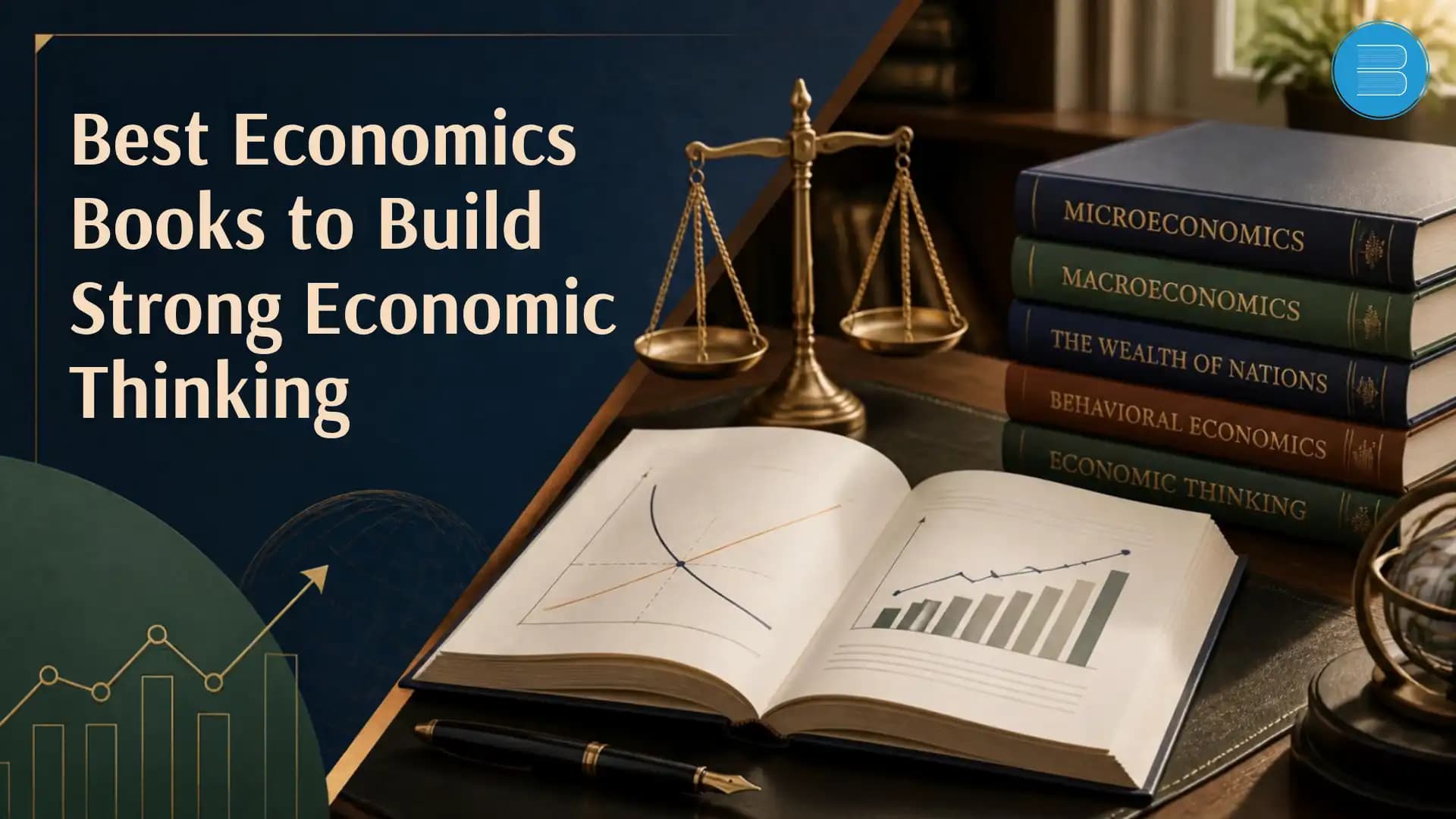
Economics may appear challenging as a study area. Graphs, rates of inflation, interest, markets, gross domestic product (GDP), trading, incentives, and monetary policy make the field seem as something that should be covered by college students in classrooms.
However, economics is actually about making rational choices due to resource, time and opportunity constraints.
That is why the Best Economics Books are unlikely to be books with lots of formulas. The most helpful books allow you to formulate better questions: why prices go up; why people react to incentives; why some countries get richer while others stay poor; why firms behave the way they do; and, lastly, why the same policy may bring completely different outcomes for different people.
The following list includes five influential yet accessible books that view economics from various perspectives. Instead of considering them all five as equally helpful recommendations, we will discuss what they can teach us, for whom the book is written, the economic mindset it develops, and what are the limitations of its view on economics.
Whether you are a reader, writer, poet, businessman, student or just an inquisitive person, these books can serve as a basis for developing your economic mindset.
Table of Content
- 5 Best Economics Books for Building Economic Thinking
5 Best Economics Books for Building Economic Thinking
There is no universally agreed single list of the best economics books of all time. Different readers need different starting points.
The five books below are therefore selected for the distinct thinking skills they develop, rather than presented as a ranking.

1. Freakonomics by Steven D. Levitt and Stephen J. Dubner
Best for: Learning to question conventional wisdom
“Freakonomics: A Rogue Economist Explores the Hidden Side of Everything” is the easiest introduction into economic way of thinking as it starts with strange questions instead of definitions.
Why does cheating happen in unrelated circumstances? What is the role of incentives in people’s behavior? What if the conventional explanation doesn’t fit the facts?
Economist Levitt and journalist Stephen J. Dubner presents peculiar examples in order to show how economic ways of thinking can reveal patterns that hide under usual behaviors.
The main idea of this book in methodological terms is not to accept the first answer you have but to ask yourself whether the facts confirm your theory.
It’s useful not only in economics.
Suppose that one school gives outstanding results of examinations. The conventional explanation may be that teachers there are better. But economic thinkers will ask more questions: were students good even before they started learning there?
Does this school choose its students? Do parents give additional assistance to their children? What else may be the reason for such results?
This difference between appearance and reality is one of the most useful ideas the reader can get from this book.
You may also like: Top 10 Human Psychology Books on Human Behavior
You may also read: 10 Books for Gifts: Find Meaningful Reads for Every Book Lover

2. Economics: The User’s Guide by Ha-Joon Chang
Best for: Beginners who want a broad introduction to competing economic ideas
If you are looking for good books to read on economics for beginners, Ha-Joon Chang’s Economics: The User’s Guide would be an excellent choice since it considers economics as a set of perspectives and not as an absolute truth.
As opposed to other writers who expect the reader to have some background in economic jargon, Chang explains key terms and schools of economic thought.
This book enables its readers to see that economists are capable of looking at the same economic situation from different perspectives and that there could be various assumptions and priorities concerning markets, government involvement, development, inequality, globalization, and economic growth.
This is an essential lesson for any person who tries to develop good economic thinking.
Economic literacy does not imply knowing one correct answer to all economic questions. It implies being aware of assumptions behind conclusions.
Why beginners may find it useful
The book can help you become comfortable with concepts such as:
- Markets
- Supply and demand
- Economic growth
- Government intervention
- Globalization
- Financial systems
- Inequality
- Economic development
It also makes an important distinction between learning economic terminology and actually learning how economies work.
You may also read: 10 Bestselling Indian Mythology Books: Explore Ancient Stories & Gods

3. Poor Economics by Abhijit V. Banerjee and Esther Duflo
Best for: Understanding poverty, development, and evidence-based economic reasoning
It is only in its application to actual human problems that economics gains strength.
“Poor Economics” addresses issues concerning poverty and development through the use of evidence in how people really make decisions under challenging economic conditions.
Instead of making assumptions based on stereotypes about poor people, Banerjee and Duflo address specific decisions related to education, health care, lending, nutrition, and other factors of everyday life.
The value of the book lies in its encouragement of reflection on the impact of small restrictions on large outcomes.
For instance, availability of a service does not mean an actual chance to use it; cost, convenience, information, incentives, and other circumstances can play roles in economic decisions.
The issue ties into general development literature, where the World Bank stresses that education, skills, productivity, poverty, and economic growth are related.
You may also read: Book Apps for iPhone: Read, Track & Discover Books
You may also like: Jester Archetype: Definition, Examples & Writing Tips
What Poor Economics teaches about economic thinking
The book encourages readers to:
- Look at evidence instead of stereotypes
- Break large problems into smaller questions
- Test assumptions
- Examine incentives
- Consider local circumstances
- Think about unintended consequences
- Evaluate whether a policy actually produces its intended outcome
This approach is valuable for understanding why a policy that sounds sensible in theory may perform differently in practice.

4. Why Nations Fail by Daron Acemoglu and James A. Robinson
Best for: Exploring institutions, political economy, and long-term development
Why are some countries much richer than others? Why is it possible for some economies to grow and innovate but not for others?
“Why Nations Fail” attempts to answer these huge questions through the prism of institutions.
The authors explain how political and economic institutions can contribute heavily to the creation of societies, which allow equal participation and economic growth or those which narrow down power and opportunities.
“Why Nations Fail” takes economic theories past individuals’ choices and encourages people to think about the context of these decisions.
It is especially helpful for those who have already come across basic economics and want to learn more about development on a broader level.
Institutional approach
Take into consideration two businessmen, both with great business ideas.
The first one works in the country with well-established laws, proper financial system, market availability and property rights security.
The second one lives in a country where contracts cannot be enforced, where political connections matter and institutions are unpredictable.
Their outcomes might be different even if their capabilities are equal.
This means that we should go beyond the individual choice and study the context.
You may also like: AI and the Future of Novels: Will Writers Be Replaced?

5. Nudge by Richard H. Thaler and Cass R. Sunstein
Best for: Understanding behavioral economics and everyday decision-making
Typically, traditional economics starts from certain assumptions about how human beings make their decisions. Behavioral economics poses an equally intriguing question:
What happens if real human beings do not always act rationally?
This is precisely what lies at the heart of Nudge.
In Nudge, Richard Thaler and Cass Sunstein discuss how choice architecture can play an important role in influencing the behavior of individuals without taking away their right to make their own choices.
For example, if there is a food court and the placement of healthier food in such a way that they become more noticeable for individuals, then they may make the right choice more often. The individual will still make his/her own choice, but the choice architecture will affect the decision making process.
What makes Nudge important?
The book helps readers recognize that decisions are affected by factors such as:
- Defaults
- Framing
- Convenience
- Social signals
- Limited attention
- Present bias
- The way choices are presented
This is particularly useful for writers and marketers because human decision-making is central to storytelling, persuasion, and communication.
It also connects economics with psychology, showing why modern economic thinking often crosses disciplinary boundaries.
Not all economic education books have to be written in nonfiction form.
There are people who are able to get economic ideas better through fiction. Fiction is an excellent way to describe unemployment, classes, wealth, inequality, business, economic crises, and social mobility using characters and conflicts.
In case you look for the best economic novels, you should consider books like The Grapes of Wrath by John Steinbeck, The Great Gatsby by F. Scott Fitzgerald, and The Jungle by Upton Sinclair, which are literary novels that may spark conversation on wealth, labor, inequality, consumption, and economic state.
But don’t think of them as books on economics. Fiction is the way of bringing humans and culture to the subject while nonfiction usually offers frameworks, data, models, and arguments on economics.
Both approaches may work wonderfully together.
For writers, both types of books are especially useful. While economics gives an explanation for social state, literature shows how it feels for the people.

0 Comments